A brief history of mycology
Ancient knowledge
Theophrastus, the Greek "father of botany", wrote about fungi in his Historia Plantarum — classifying them as plants without roots, leaves, or seeds. He was wrong about the classification but right that they were extraordinary. Truffles were prized in ancient Rome; Pliny the Elder described their harvesting in detail and called them "the greatest of all miracles of nature."
The oldest images
Sculpted mushroom images traced to 1300 BC in Mexico and Guatemala. Prehistoric etchings depicting fungi have also been found in ancient Egyptian, Indian, and Sumerian civilisations. Mushroom consumption has been dated to around 13,000 years ago from archaeological evidence at Chilean ruins. Written evidence of cultivation and medicinal use appears several hundred years BC in China.
Ötzi the Iceman
The 5,300-year-old mummy discovered in the Austrian Alps was carrying two species of polypore mushrooms: Fomes fomentarius (tinder fungus, used to carry fire) and Piptoporus betulinus. Ötzi was infected with a gut parasite, and Piptoporus contains compounds with antiparasitic properties — suggesting deliberate medicinal use. He was carrying his medicine. This is the oldest known evidence of intentional fungal use by a human being.
The first famous poisoning
Roman Emperor Claudius Caesar is believed to have been murdered with Amanita phalloides — the death cap — concealed in food. Documented by Wasson and Wasson (1957). Roman Caesars employed food tasters specifically for mushrooms, which tells you something about both how prized and how feared they were. Amanita phalloides remains responsible for the majority of fatal mushroom poisonings worldwide today.
Della Porta identifies spores
G. della Porta became the first to identify mushroom spores as seeds — a foundational observation that established fungi as reproducing organisms rather than spontaneous growths. This preceded Micheli's formal work by over a century.
Robert Hooke and the microscope
Robert Hooke published Micrographia — containing the first drawings of fungal sporangia seen through a microscope. Around the same time, Leeuwenhoek was making yeast observations with his own microscope. The microscope didn't just magnify fungi — it revealed that they had structure, that they reproduced, that they were organisms rather than outgrowths of decay.
Saccardo's monumental catalogue
P.A. Saccardo published Sylloge Fungorum — a monumental species catalogue that attempted to document all known fungi. A landmark of pre-molecular mycology and still referenced today. Saccardo described thousands of species and established a nomenclature framework that governed the field for decades.
Cyclosporin isolated
Cyclosporin A — the immunosuppressant drug that makes organ transplants possible — was first isolated from the fungus Tolypocladium inflatum. It remains one of the most important drugs in transplant medicine. The fungal kingdom had already given us penicillin, griseofulvin, and cephalosporin. Cyclosporin confirmed that fungi were not a marginal source of pharmaceutical compounds but a primary one.
Cordyceps and the Chinese athletes
At the 1993 Beijing National Games, Chinese women athletes broke multiple world records. Their coach attributed the performance in part to Cordyceps sinensis supplementation — caterpillar fungus, a parasitic species used in traditional Chinese medicine for centuries as a tonic. The claim was controversial and the records were later questioned on other grounds, but it brought Cordyceps to global attention and triggered a wave of research into its compounds, including cordycepin and adenosine.
Micheli names the spores
Pier Antonio Micheli, an Italian botanist, published Nova Plantarum Genera — the first systematic attempt to classify fungi. More importantly, he demonstrated that spores could germinate into new fungi, disproving the prevailing theory of spontaneous generation for this group. He described over 900 species and is considered the founder of mycology.
Linnaeus and the plant kingdom mistake
Carl Linnaeus published Species Plantarum and placed fungi in the plant kingdom — a classification error that would persist for over 200 years. To be fair to Linnaeus, he didn't think much of fungi at all, describing them as "the poor peasants of the plant kingdom." He listed only around 80 species, and the description was perfunctory.
Fries and the foundation of modern classification
Elias Magnus Fries published Systema Mycologicum — a three-volume classification of fungi that became the foundation for all subsequent work. He described thousands of species and established a systematic approach that, despite being pre-molecular, was remarkably accurate. His species descriptions are still considered valid under the International Code of Nomenclature.
Beatrix Potter and the lichen controversy
Yes — that Beatrix Potter. Before Peter Rabbit, she was a serious amateur mycologist who produced extraordinarily detailed illustrations of fungi and lichen. She proposed, independently and correctly, that lichen are symbiotic organisms — a fungus and an alga living together. The scientific establishment, personified by the Director of Kew Gardens, refused to take her seriously because she was a woman. She was right. They were wrong. She went on to write children's books instead.
Fleming and penicillin
Alexander Fleming returned from holiday to find a Penicillium mould had contaminated one of his bacterial cultures — and that a clear zone around the mould was free of bacteria. He published his findings in 1929. The discovery went largely ignored for a decade until Howard Florey and Ernst Chain developed it into a usable drug in the 1940s. It has since saved an estimated 200 million lives.
Wasson and the "mushroom ceremony"
R. Gordon Wasson, a banker and amateur ethnomycologist, published an account in Life magazine of participating in a Mazatec mushroom ceremony in Oaxaca with María Sabina — the first time psilocybin mushrooms were introduced to the Western mainstream. The article was read by Albert Hofmann (who had synthesised LSD), who went on to isolate psilocybin in 1958. It was the beginning of a very strange few decades.
Whittaker's five kingdoms
Robert Whittaker proposed a five-kingdom system that finally gave fungi their own kingdom — separate from plants, animals, protists, and bacteria. It took until the 1970s and 80s for this to be widely adopted, but it was the formal recognition that fungi are genuinely their own thing.
Molecular revolution
The development of PCR (polymerase chain reaction) and DNA sequencing transformed mycology. For the first time, species could be compared at the genetic level rather than just by appearance. The results were humbling — vast numbers of species described as distinct turned out to be the same, and enormous numbers of apparently identical species turned out to be different. The estimated number of fungal species went from around 70,000 to current estimates of 2–6 million. Whole families were reorganised. The fungal tree of life was almost entirely redrawn.
The popular turn
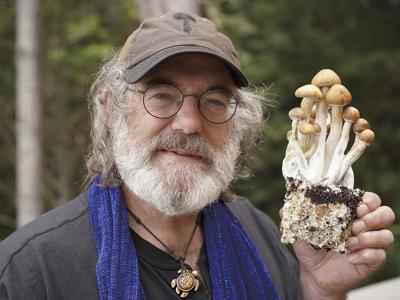
A combination of Paul Stamets' TED talk (2008), the publication of Entangled Life by Merlin Sheldrake (2020), Michael Pollan's How to Change Your Mind (2018), and several high-profile clinical trials of psilocybin at Johns Hopkins and NYU brought fungi to mainstream attention in a way that had never happened before. The explosion of interest in cultivation, foraging, and medicinal mushrooms that followed is still ongoing.